.png)


We need to talk about public sector pensions

Whenever public spending is scrutinised, the welfare bill is quite rightly raised as an increasing and unsustainable part of the government budget that needs to be addressed. Talk is often focused on the size of the state pension deficit within the welfare budget, but one aspect that seems to escape true scrutiny is public sector pensions.
The employers’ contribution rates for public sector workers are eye-watering compared with those of the private sector. Whereas a private sector worker might expect their employer to contribute typically in the region of 4-5% of their gross salary towards their pension (although some companies will pay a higher percentage), in the public sector, this rate can be approaching 30% of annual salary.
At a time when public sector workers are increasingly demanding pay parity with their private sector equivalents, the justification for maintaining such high levels of taxpayer-funded pension contributions seems more and more flimsy.
Public sector workers can’t have it both ways… they can’t spend their working life perpetually on strike whilst demanding pay rises that align their earnings with the private sector, and simultaneously expecting to retain the gold-plated pension and benefits packages that only the public sector offers.

Government employer contribution rates averaged 28.6% of pensionable pay across main unfunded schemes in 2023/24 (up from 23-25% in the prior year). Applied to a public sector paybill of c. £250-£300 billion annually, this equates to taxpayer funded employer contributions of £70-£85 billion pa.
Specific examples of excessive contribution rates include the Civil Service, where the employer rate has been 28.6% since April 2022, and the NHS with an average 23.7-24.8% rate in 2024/25.
Aligning public sector pensions to private sector rates would be a complex exercise, involving having to navigate legal protections for pensions promises, and with the expectation that accrued rights for existing pension scheme members would be protected (i.e. any changes would only apply to new members moving forwards, and not retrospectively impact existing members). It would also likely mean shifting to a Defined Contribution model, or significantly reducing Defined Benefit generosity.
However, the savings that could be generated by reducing average public sector pay rates by half (which would provide an employers contribution rate in excess of 14%, still significantly higher than average private sector contribution rates of c. 6%) could save the treasury in excess of £42bn per year.
Take the NHS pension as a case in point.
The Employers Contribution to NHS staff pensions (i.e. the amount that is paid into staff members’ pensions by their employer, or in this case the taxpayer) is currently at a staggering 23.7% of gross annual salary, which is an increase from the previous rate of 20.6%. To put that into context, the minimum contribution that employers in the private sector are obliged to make to staff pensions is just 3%. The average private sector employer pension contribution is between 4% - 5% of gross salary.
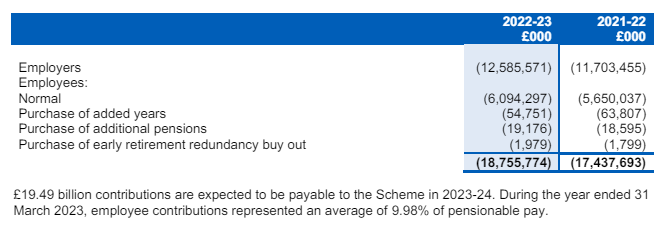
In the 2022-23 tax year, this equated to a £12.5billion in cost from the NHS budget, which was up by £0.8billion from 2021-22. With the contribution rate having risen again, the cost to the taxpayer of paying into NHS staff pensions for the 2024-25 tax year will be in the region of £14.5bn.
The overtly generous NHS pension scheme is one of the key driving factors behind why so many of our doctors are retiring so early. By the age of 50, most have consistently had an amount equivalent to £26,461 paid into their pensions by the taxpayer, on top of the contributions that the doctors pay in themselves from their own salary (the “Employees Contribution”), each and every year, for a period of over 20 years.
The top employer’s contribution rate in the NHS pension scheme has risen by nearly 10 percentage points in less than 10 years, from 14.5% in 2015.
Traditionally, the reason why pensions were so high in the NHS (and the public sector as a whole, relative to the private sector) was because it was seen as a trade-off to lower wages. The generally accepted principle was that core pay levels in the public sector are lower than in the private sector, because they are publicly funded and pay rates must therefore reflect value for the taxpayer.
But this was compensated for with a generous benefits entitlement, including a significant public sector pension, annual leave entitlement, life assurance schemes etc. in addition to greater job security than is enjoyed in the private sector.
However, with many NHS staffing groups increasingly demanding inflation-busting pay rises, this concept seems to have been forgotten. At a time when the NHS budget is stretched so thin, and radical reform needed of how taxpayer funding into the health system is being distributed, such a huge contribution to staff pensions can no longer be afforded or justified.
To reduce the employers NHS pension contribution to be more in line with the private sector at 5%, would save approximately £11.5billion a year. Even if you wanted to keep the levels above those of the private sector, so as not to discourage staff from leaving the NHS, and set the contribution rate at 10% or 15%, this would still save £8.3billion or £5.3bn a year respectively.
That is significantly more than Labour expects to raise through either of its flagship taxation policies of taxing individuals with Non-Dom tax status, or charging VAT on private school fees, yet is not a policy that we have heard any of the main parties contemplate when considering how to get better value for the taxpayer from the enormous NHS budget.
Only Reform UK have mentioned looking into public sector pensions with a view to better alignment with the private sector. The other parties are simply too scared to consider it, due to the pushback they will inevitably feel from the millions of public sector workers in this country, including those in Whitehall who will try their hardest to block any modifications attempted in this area.



Comments